
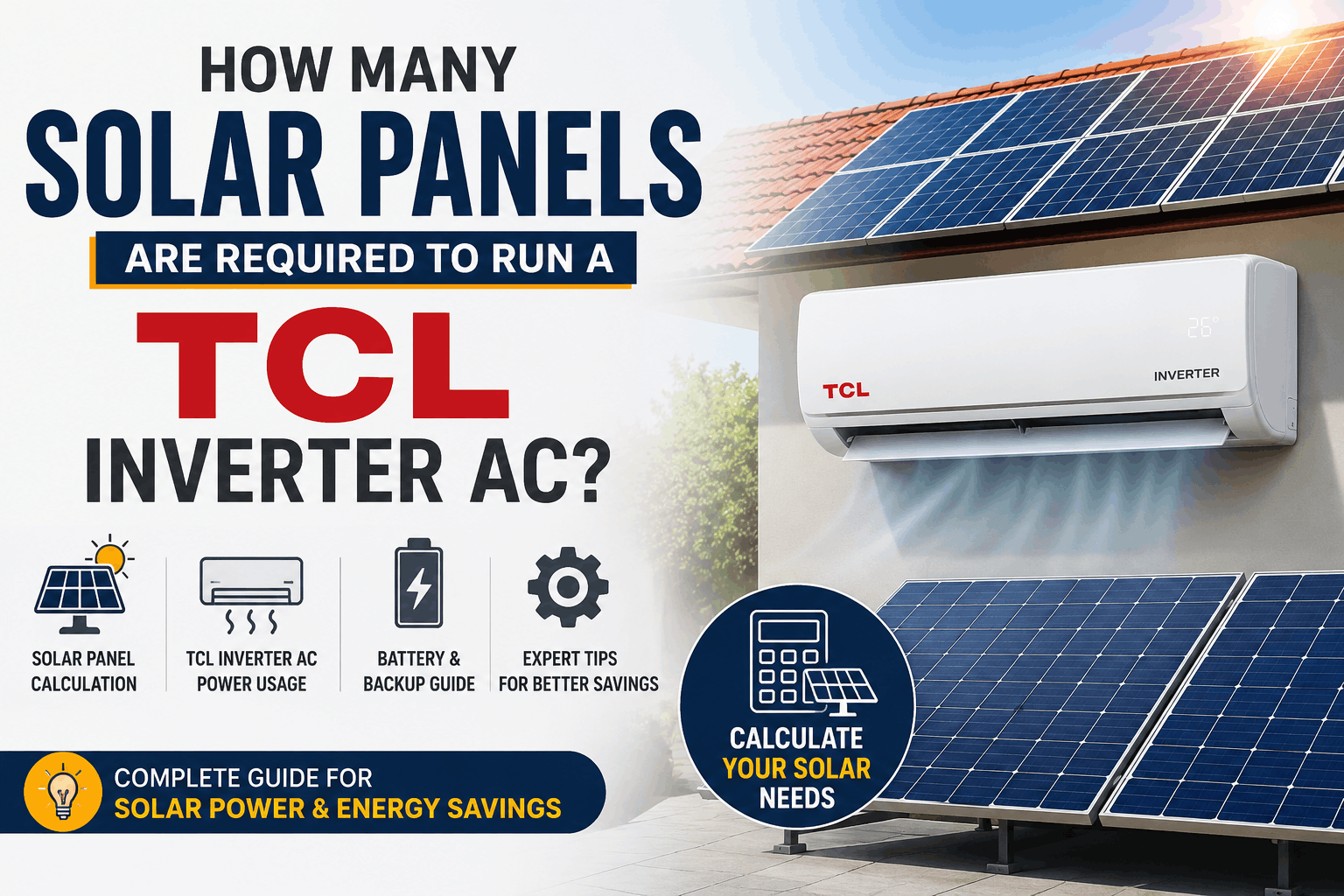
If you’re thinking about installing solar panels, there’s a good chance your air conditioner is the biggest reason.
Electricity prices in Pakistan have increased significantly over the past few years, and for many households, the air conditioner is the appliance that adds the most to the monthly bill. During the summer, it’s not unusual for an inverter AC to run for eight to twelve hours a day, especially in cities like Lahore, Multan, Faisalabad, and Karachi, where temperatures often remain above 40°C.
That’s why more homeowners are asking the same question:
Can I run my TCL inverter AC on solar panels?
The short answer is yes, but the number of solar panels you’ll need depends on more than just the AC’s tonnage.
A 1 Ton TCL inverter AC doesn’t require the same solar capacity as a 2 Ton model. Even two homes using the exact same air conditioner can have different solar requirements because factors like room temperature, insulation, sunlight hours, and the number of other appliances running at the same time all affect power consumption.
Many people also assume they only need to match the AC’s wattage with the solar panels. In reality, a properly designed solar system also needs to account for inverter efficiency, weather conditions, wiring losses, and future electricity needs. Ignoring these factors often results in a system that performs well in winter but struggles to keep the AC running during Pakistan’s hottest months.
In this guide, we’ll explain how much electricity a TCL inverter AC actually consumes, how many solar panels are typically required for 1 Ton, 1.5 Ton, and 2 Ton models, whether a 3kW solar system is enough for a 1.5 Ton unit, and whether you need batteries to run your AC on solar power. We’ll also compare off-grid and hybrid solar systems to help you decide which setup makes the most sense for your home.
By the end of this article, you’ll have a much clearer idea of how to size a solar system that can comfortably run your TCL inverter AC without overspending on equipment you don’t need.
How Much Solar Power Does a TCL Inverter AC Consume?
One of the biggest misconceptions about inverter air conditioners is that they always consume the amount of electricity printed on the specification sheet.
That’s not how an inverter AC works.
Unlike a conventional air conditioner, a TCL inverter AC doesn’t keep switching its compressor completely on and off. Instead, it adjusts the compressor speed according to the room temperature. When you first turn the AC on during a hot afternoon, the compressor works at maximum capacity to cool the room quickly. Once the desired temperature is reached, it slows down and uses much less electricity to maintain that temperature.
That’s why the actual power consumption changes throughout the day.
Startup Power vs Running Power
When an inverter AC starts, it briefly draws more electricity because the compressor needs extra power to begin operating. This is known as the startup load.
Fortunately, inverter technology keeps this startup surge much lower than older fixed-speed air conditioners.
After the room cools down, the compressor doesn’t continue running at full power. Instead, it gradually reduces its speed, which is where most of the electricity savings come from.
This is the main reason inverter ACs are considered much more energy efficient than non-inverter models.
Estimated Power Consumption by AC Size
While exact electricity usage varies from model to model, most TCL inverter air conditioners fall within these approximate ranges during normal operation.
| AC Capacity | Average Running Power | Typical Hourly Consumption |
| 1 Ton | 700–1,000 watts | 0.7–1.0 kWh |
| 1.5 Ton | 1,000–1,500 watts | 1.0–1.5 kWh |
| 2 Ton | 1,500–2,000 watts | 1.5–2.0 kWh |
Remember, these are average operating figures. During extremely hot afternoons, the compressor may run closer to its maximum capacity for longer periods before reducing its speed.
Daily Electricity Consumption
To estimate the size of your solar system, it’s more useful to think in terms of daily energy usage rather than hourly consumption.
Here’s an example for a 1.5 Ton TCL inverter AC.
| Daily Usage | Estimated Electricity Consumption |
| 6 hours | 6–9 kWh |
| 8 hours | 8–12 kWh |
| 10 hours | 10–15 kWh |
These figures assume normal summer conditions and average compressor operation. Your actual consumption may be lower during cooler weather or higher during peak summer when outdoor temperatures remain above 40°C.
What Affects Power Consumption?
Two households using the same TCL inverter AC can end up with very different electricity bills.
That’s because several factors influence how hard the compressor has to work.
Outside Temperature
An air conditioner operating on a 32°C day consumes much less electricity than one trying to cool a room when it’s 45°C outside.
This is one of the reasons AC power consumption increases during June and July in many parts of Pakistan.
Room Insulation
Rooms with insulated roofs, double-glazed windows, and properly sealed doors stay cool for longer.
Poorly insulated rooms allow heat to enter continuously, forcing the compressor to run more often.
Desired Temperature
Many people immediately set their AC to 18°C.
While the room may cool slightly faster at first, the compressor has to work much harder to maintain such a low temperature. Setting the thermostat between 24°C and 26°C usually provides a comfortable balance between cooling and energy efficiency.
Fan Speed
Higher fan speeds help circulate cool air more quickly throughout the room.
Although the fan itself doesn’t consume much electricity, it can influence how long the compressor operates before reaching the target temperature.
Compressor Load
The compressor is responsible for most of an air conditioner’s electricity consumption.
When the room reaches the desired temperature, an inverter compressor slows down instead of shutting off completely. This reduced compressor speed is what makes inverter ACs significantly more efficient than traditional non-inverter models.
How Many Solar Panels Are Required to Run a TCL Inverter AC?
This is the question almost every homeowner asks before investing in solar.
Unfortunately, there’s no single answer because the number of solar panels depends on more than just the size of your air conditioner.
For example, a family in Lahore that runs a 1.5 Ton TCL inverter AC for eight hours a day will need a different solar setup than someone in Islamabad who only uses the AC for four or five hours in the evening. The same applies if you’re planning to run other appliances such as a refrigerator, lights, or a water pump alongside the AC.
That’s why solar installers don’t simply ask, “What size is your AC?” They also look at your daily electricity consumption, roof space, sunlight hours, and the rest of your household’s electrical load.
Understanding Solar Panel Output
Most residential solar installations in Pakistan now use 550W to 585W mono PERC or N-Type solar panels because they offer a good balance between efficiency and roof space.
Although a panel may be rated at 585 watts, it won’t produce 585 watts throughout the day.
Solar production changes depending on:
- The intensity of sunlight.
- The angle of the sun.
- Panel temperature.
- Dust accumulation.
- Cloud cover.
- Inverter efficiency.
On a clear summer day, a 585W panel can produce roughly 2.5 to 3.2 kWh of electricity per day in many parts of Pakistan. This is why solar systems are designed based on daily energy production, not just the panel’s peak wattage.
Estimated Solar Panels Required
The table below gives a practical estimate for running only the air conditioner during daylight hours.
| TCL Inverter AC | Average Daily Usage | Recommended Solar System | Approx. 585W Panels |
| 1 Ton | 6–8 hours | 2–2.5 kW | 4–5 Panels |
| 1.5 Ton | 8 hours | 3–3.5 kW | 6 Panels |
| 2 Ton | 8–10 hours | 4–5 kW | 7–9 Panels |
These are planning estimates rather than fixed requirements. A qualified installer will size the system according to your actual electricity usage and site conditions.
Why Solar Systems Are Usually Oversized
Many homeowners calculate their solar requirement using only the AC’s electricity consumption.
In practice, installers intentionally design slightly larger systems.
Here’s why.
Battery Losses
If your system includes batteries, some electricity is lost while charging and discharging them.
Although modern lithium batteries are highly efficient, they’re not 100% efficient. A portion of the generated energy is always lost during storage.
Inverter Losses
The electricity produced by solar panels must pass through the solar inverter before your appliances can use it.
During this conversion process, a small percentage of energy is lost.
High-quality inverters are generally more efficient, but some energy loss is unavoidable.
Weather Conditions
Solar panels don’t generate the same amount of electricity every day.
Their performance changes with:
- Cloudy weather.
- Rain.
- Winter sunlight.
- Heavy smog.
- High temperatures.
A system that performs perfectly in April may produce noticeably less electricity during foggy winter mornings.
Future Electricity Needs
Another reason installers recommend a slightly larger system is future expansion.
Today you may only want to run one TCL inverter AC.
Next year you might add:
- Another air conditioner.
- An electric geyser.
- A deep freezer.
- An electric vehicle charger.
Adding a few extra panels during the initial installation is usually more cost-effective than upgrading the system later.
Is Bigger Always Better?
Not necessarily.
Some people believe installing the largest solar system they can afford is always the smartest decision.
In reality, an oversized system isn’t always the most economical option.
For example, if your household only consumes around 12 to 15 units of electricity per day, installing a 10kW solar system may take much longer to recover its cost than a properly sized 5kW system.
The goal isn’t to install the biggest system.
The goal is to install the right-sized system based on your actual electricity usage.
A professional solar assessment should consider:
- Your monthly electricity bills.
- The number of people living in the house.
- Your AC usage during summer.
- Future expansion plans.
- Available roof space.
- Local weather conditions.
Example: A Typical Pakistani Household
Let’s say a family in Lahore owns:
- One 1.5 Ton TCL Inverter AC
- One refrigerator
- Five ceiling fans
- Ten LED lights
- One LED television
- A Wi-Fi router
During peak summer, their daily electricity consumption may range between 18 and 24 kWh, depending on how long the air conditioner operates.
In this situation, a 3kW solar system may comfortably support daytime cooling while also supplying electricity for the household’s essential appliances during sunny hours.
However, if the AC runs for longer periods or additional heavy appliances such as a water pump, microwave, or washing machine are used simultaneously, a 5kW system often provides a more comfortable margin and better long-term flexibility.
The important takeaway is this:
Don’t size your solar system around the air conditioner alone. Size it around your home’s total electricity demand.
Can a 1.5 Ton TCL Inverter AC Run on a 3kW Solar System?
This is one of the most common questions Pakistani homeowners ask—and the answer is yes, in many situations.
A 3kW solar system can usually run a 1.5 Ton TCL inverter AC, but its performance depends on when you’re using the AC and what other appliances are running at the same time.
During bright summer afternoons, when solar panels are producing their highest output, a properly installed 3kW system can comfortably power a 1.5 Ton TCL inverter AC while still supplying electricity to several essential household appliances.
For example, a typical household may be able to run:
- One 1.5 Ton TCL inverter AC
- One refrigerator
- Four to six ceiling fans
- LED lights
- One television
- Wi-Fi router
- Mobile phone chargers
Under these conditions, the solar system is making full use of the available sunlight, allowing the AC to operate efficiently without drawing much electricity from the grid.
When Does a 3kW System Become Insufficient?
The situation changes if you begin adding several high-power appliances at the same time.
For example:
- Electric iron
- Microwave oven
- Electric kettle
- Water pump
- Washing machine with heating element
- Additional air conditioner
These appliances can quickly increase the household’s electricity demand beyond what a 3kW system can comfortably supply.
The time of day also matters.
Late in the afternoon, when sunlight becomes weaker, solar production gradually decreases. Even if your AC continues to operate efficiently, the system may begin importing electricity from the grid unless battery storage or net metering is available.
For homeowners who mainly use their TCL inverter AC during daylight hours, a well-designed 3kW hybrid solar system is often a practical and cost-effective solution.
However, if your household regularly uses multiple heavy appliances together or you plan to expand your electrical load in the future, investing in a larger system from the start can help avoid expensive upgrades later.
Off-Grid vs Hybrid Solar: Which Is Better for Running a TCL Inverter AC?
If you’re planning to install solar specifically to reduce your air conditioning bill, you’ll eventually come across two options: off-grid solar and hybrid solar.
At first glance, they may seem similar because both use solar panels to generate electricity. However, they work differently and are designed for different types of homes.
Choosing the right system isn’t just about cost. It also affects how reliably your TCL inverter AC will run during cloudy weather, load shedding, and at night.
Let’s look at both options.
Off-Grid Solar System
An off-grid solar system operates completely independently of the electricity grid.
It generates electricity through solar panels and stores excess energy in batteries for later use. Since there’s no connection to the utility grid, your home relies entirely on solar production and battery storage.
Advantages
- Continues working even if there’s a long power outage.
- Suitable for remote areas where grid electricity isn’t available.
- Provides complete energy independence.
- Ideal for locations with frequent and extended load shedding.
Disadvantages
- Higher installation cost because batteries are essential.
- Battery replacement adds to long-term maintenance expenses.
- Limited backup if the battery bank isn’t large enough.
- Expanding the system later can be more expensive.
Best For
An off-grid system is a practical choice for:
- Rural homes without reliable electricity.
- Farmhouses.
- Remote villages.
- Areas where power outages last for several hours every day.
For most urban households in Pakistan, however, an off-grid system isn’t always the most economical solution because battery storage significantly increases the overall project cost.
Hybrid Solar System
A hybrid solar system combines solar panels, batteries (optional), and the national electricity grid.
During the day, your TCL inverter AC runs primarily on solar energy. If solar production drops because of cloudy weather or sunset, the system automatically switches to battery power or imports electricity from the grid.
This transition happens automatically, so there’s no need to manually change power sources.
Advantages
- Makes maximum use of solar energy during daylight hours.
- Can use battery backup during load shedding.
- Imports electricity from the grid whenever solar production isn’t sufficient.
- Easier to expand as household electricity needs increase.
- Compatible with net metering on approved systems.
Disadvantages
- Higher upfront cost than a simple on-grid system.
- More components mean slightly more complex installation.
- Battery backup increases the overall project cost if included.
Best For
Hybrid systems are usually the better choice for:
- Homes in major cities.
- Families using air conditioners daily.
- Homeowners planning for future expansion.
- Areas where electricity is available but load shedding still occurs.
Which System Makes More Sense in Pakistan?
For most Pakistani homeowners, a hybrid solar system is the more practical option.
Why?
Because it gives you flexibility.
During sunny hours, your TCL inverter AC can operate primarily on solar energy. If clouds reduce solar production or electricity demand suddenly increases, the system automatically draws power from the grid or battery without interrupting cooling.
That combination is particularly useful during Pakistan’s summer months, when electricity demand is high and occasional power interruptions still occur in many areas.
Unless your home is completely off the electricity grid, a hybrid system usually provides the best balance between reliability, convenience, and long-term value.
Can You Run a TCL Inverter AC Without Batteries on Solar?
Yes—you can.
This surprises many homeowners because there’s a common belief that every solar system must include batteries.
In reality, many modern solar installations operate perfectly without battery storage.
The key difference is when you want to use your air conditioner.
During Daylight Hours
If your TCL inverter AC is running while the sun is shining and your solar panels are producing enough electricity, batteries aren’t necessary.
The electricity generated by the panels flows through the inverter and directly powers your household appliances, including the air conditioner.
This is why many homeowners prefer to operate their AC during the hottest part of the day, when solar production is also at its highest.
What Happens After Sunset?
Once the sun goes down, solar panels stop generating electricity.
Without batteries, your home automatically begins using electricity from the national grid.
The air conditioner continues running normally, but it is no longer powered by solar energy.
If your area experiences load shedding at night and you don’t have battery backup, the AC will switch off along with the rest of the household appliances.
What About Net Metering?
Many homeowners confuse net metering with battery storage.
They’re not the same thing.
With net metering:
- Extra electricity generated during the day is exported to the utility grid.
- The electricity company records those exported units.
- You can later offset some of your nighttime electricity usage through billing credits.
However, net metering doesn’t keep your air conditioner running during a power outage.
If the electricity grid goes down, an ordinary on-grid system automatically shuts down for safety reasons.
When Are Batteries Worth Installing?
Adding batteries makes sense if:
- Your area experiences frequent load shedding.
- You want to run your TCL inverter AC during power outages.
- You need backup for important appliances such as lights, fans, Wi-Fi, or medical equipment.
- You prefer greater energy independence.
If your main objective is simply reducing electricity bills and you already have a reliable grid connection, many homeowners find that a hybrid or on-grid solar system without batteries offers the best return on investment.
Factors That Affect Solar Performance
Even the best solar system won’t produce the same amount of electricity every day.
Several environmental and installation factors influence how much energy your panels generate and, ultimately, how efficiently they can support your TCL inverter AC.
Understanding these factors helps set realistic expectations before investing in a solar system.
Weather Conditions
Pakistan’s climate varies significantly from one city to another.
For example:
- Lahore experiences intense summer heat along with seasonal smog that can reduce solar production.
- Karachi generally receives strong sunlight throughout the year but may see reduced panel performance because of coastal dust and humidity.
- Peshawar enjoys excellent solar potential but experiences shorter daylight hours during winter.
Although solar panels work across all these regions, daily electricity production isn’t identical.
Dust and Dirt
Dust is one of the most overlooked reasons for lower solar output.
A thin layer of dust may not seem important, but over time it can block sunlight and reduce electricity generation.
This is particularly common in cities with dry weather and ongoing construction activity.
Cleaning solar panels periodically helps maintain their efficiency throughout the year.
Roof Direction and Tilt
The direction your panels face has a noticeable impact on electricity production.
Panels installed at the correct angle receive more direct sunlight during the day, improving overall system performance.
A poorly positioned installation may generate less electricity even if the number of panels remains the same.
Summer vs Winter
Solar systems generally produce more electricity during the longer days of summer.
However, extremely high temperatures can slightly reduce panel efficiency.
In winter, cooler temperatures actually improve panel performance, but shorter daylight hours mean total daily electricity generation is usually lower.
Panel Quality
Not all solar panels perform equally.
Higher-quality panels generally:
- Maintain better efficiency over time.
- Perform better during hot weather.
- Produce more electricity from the same roof area.
- Degrade more slowly over their lifespan.
Although premium panels usually cost more initially, they often deliver better long-term value.
Household Electricity Usage
Your solar system doesn’t operate in isolation.
If multiple high-power appliances are switched on together, the available solar energy must be shared between them.
Running a TCL inverter AC alongside heavy appliances such as electric geysers, irons, ovens, or water pumps increases the household’s total electricity demand and may require importing additional electricity from the grid.
For this reason, solar system sizing should always consider the home’s complete energy usage rather than focusing only on the air conditioner.
Common Mistakes People Make When Choosing a Solar System for a TCL Inverter AC
Installing a solar system is a long-term investment, so getting the sizing and equipment right from the beginning is important.
Unfortunately, many homeowners make decisions based solely on price or advice from unqualified installers. These mistakes often lead to lower energy savings, poor system performance, or expensive upgrades later.
Here are some of the most common mistakes to avoid.
Buying a Solar System That’s Too Small
A common misconception is that you only need enough solar panels to run your air conditioner.
In reality, your solar system has to support your home’s total electricity demand. While the AC may be the largest power consumer, other appliances continue running throughout the day.
If the system is undersized, you’ll end up importing more electricity from the grid than expected, reducing the financial benefits of going solar.
Before choosing a system size, calculate your average daily electricity consumption instead of focusing on a single appliance.
Ignoring Inverter Capacity
Solar panels generate electricity, but it’s the solar inverter that distributes that power to your home.
If the inverter isn’t properly matched to the system size, it can become a bottleneck even when the panels are producing enough electricity.
Always ensure the inverter has sufficient capacity to handle your expected electrical load, including your TCL inverter AC and other major appliances.
Overlooking Peak Power Demand
Although inverter air conditioners have a much lower startup surge than conventional ACs, they still require additional power when the compressor starts.
If multiple appliances start operating at the same time, the total load can briefly increase.
A properly designed solar system should account for these temporary power demands rather than relying only on average electricity consumption.
Choosing Cheap Components
Trying to reduce installation costs by purchasing low-quality equipment often becomes more expensive in the long run.
Poor-quality inverters, substandard wiring, and unreliable mounting structures can reduce system efficiency and increase maintenance costs.
A solar system is expected to operate for more than two decades, so investing in quality components usually provides better long-term value than choosing the cheapest available option.
Poor Installation Practices
Even high-quality equipment won’t perform well if it’s installed incorrectly.
Some common installation issues include:
- Incorrect panel orientation.
- Poor roof layout.
- Loose electrical connections.
- Inadequate cable protection.
- Insufficient ventilation around the inverter.
Working with an experienced and certified installer helps ensure the system operates safely and efficiently.
Not Planning for Future Expansion
Many homeowners install a solar system based only on their current electricity usage.
However, household energy needs often increase over time.
You may eventually purchase:
- Another air conditioner.
- A larger refrigerator.
- An electric vehicle.
- A water pump.
- Additional household appliances.
Considering future expansion during the planning stage can save both time and money compared to upgrading the system later.
Is Solar Worth It for Running a TCL Inverter AC?
For many households in Pakistan, the answer is yes.
Air conditioners account for a significant portion of residential electricity consumption during the summer months. Running an inverter AC on solar energy can noticeably reduce monthly electricity bills while also lowering dependence on the national grid.
However, whether solar is a worthwhile investment depends on your electricity usage, available roof space, and long-term plans.
Initial Investment
Installing a solar system requires a considerable upfront investment.
The overall cost depends on several factors, including:
- System size.
- Solar panel quality.
- Inverter type.
- Battery storage (if required).
- Installation charges.
Although the initial expense may seem high, solar systems are designed to provide savings over many years.
Monthly Savings
One of the biggest advantages of using solar is reducing the amount of electricity purchased from the grid.
If your TCL inverter AC operates mainly during daylight hours, much of its electricity demand can be supplied directly by solar panels. This can significantly lower monthly electricity bills, especially during the summer when air conditioners are used most frequently.
Homes with higher daytime electricity consumption generally benefit the most from solar energy.
Payback Period
The time required to recover your investment depends on factors such as:
- System cost.
- Daily electricity usage.
- Local electricity tariffs.
- Solar energy production.
- Whether net metering is available.
For many homeowners, the long-term savings continue well beyond the payback period, making solar a financially attractive investment.
Who Benefits the Most?
Solar is usually a good option for homeowners who:
- Use their TCL inverter AC regularly during the day.
- Receive strong sunlight throughout the year.
- Have enough roof space for solar panels.
- Plan to stay in the same home for many years.
- Want greater protection against rising electricity prices.
If your daytime electricity usage is minimal or your roof has significant shading, the financial benefits may be lower. In such cases, a professional site assessment can help determine whether solar is the right choice.
Final Thoughts
Running a TCL inverter AC on solar power is not only possible but also a practical solution for many households in Pakistan. The key is choosing a solar system that’s designed around your overall electricity consumption rather than focusing solely on the air conditioner.
While a 1 Ton AC generally requires a smaller system, 1.5 Ton and 2 Ton models often need additional solar capacity, especially if other household appliances operate at the same time. Factors such as weather conditions, roof orientation, inverter efficiency, and future electricity needs should also be considered before deciding on a system size.
For most urban homes, a hybrid solar system offers the best balance of flexibility and reliability. It allows you to make the most of solar energy during the day while still drawing power from the grid or battery backup when needed.
Before making a final decision, consult a qualified solar installer, Lahore Centre who can assess your home’s energy requirements, roof conditions, and future electricity needs. A properly designed system will deliver better performance, greater energy savings, and reliable operation for years to come.
Meta description:
how many solar panels are required to run a TCL inverter AC. Find power consumption, 3kW solar compatibility, battery needs, and expert sizing tips
