
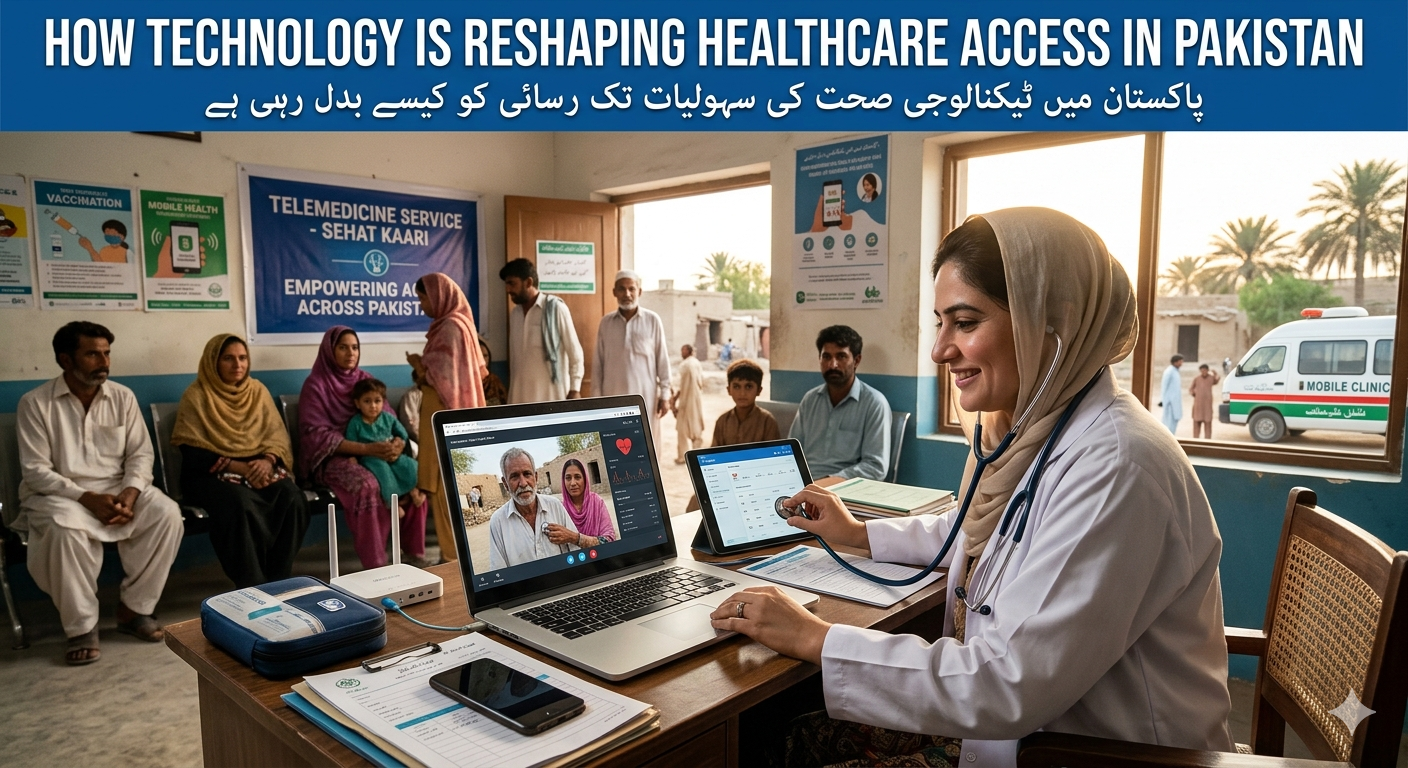
Think about what a smartphone does in a Pakistani household today. It connects families across cities. It handles banking, shopping and entertainment. It is how news is consumed, how opinions are formed and how businesses are run from a kitchen table. But quietly, without most people noticing the shift, the smartphone has taken on a role that may matter more than all of those combined: it has become the most important healthcare access tool in the country.
This is not a projection about the future. It is already happening. Across Pakistan, doctors are consulting patients via video call, diagnostic results are being shared through WhatsApp, rehabilitation sessions are being delivered over a stable internet connection to patients who would otherwise go without. The technology that TechPrice.pk covers every day — the handsets, the networks, the devices — is quietly powering a healthcare transformation that is reaching people the traditional system never could.
Consider stroke rehabilitation, one of the most demanding and most neglected areas of healthcare in Pakistan. A haemorrhagic stroke — bleeding in the brain — frequently leaves survivors with speech and language difficulties that require months of specialist therapy to address. In the past, patients in Rawalpindi or outside the major urban centres had very little access to this kind of support. Today that is changing. Specialist clinics offering speech therapy for hemorrhage in Islamabad are now providing both in-person and online sessions, meaning a stroke survivor recovering at home no longer has to choose between consistent therapy and the practical impossibility of travelling to a clinic several times a week. The smartphone made that possible. A stable 4G connection and a clinic willing to deliver sessions remotely is all it takes.
This is one example among hundreds. The convergence of affordable devices, expanding network coverage and a growing ecosystem of digital health services is quietly rewriting what healthcare access means in Pakistan — and it is worth understanding how.
The Smartwatch Is No Longer Just a Gadget
A few years ago, a smartwatch in Pakistan was a luxury item. A fashion accessory for tech enthusiasts, a conversation piece at best. Today, mid-range smartwatches available through Pakistani retailers offer continuous heart rate monitoring, blood oxygen measurement, irregular rhythm detection and sleep analysis. Devices that cost a fraction of what they did two years ago are now generating clinical-grade data for the people wearing them.
This matters more than most people realise. Conditions like hypertension, atrial fibrillation and diabetes are among the leading drivers of serious illness in Pakistan. They are also conditions that are most effectively managed through continuous monitoring, not occasional clinic visits. A patient whose smartwatch flags an elevated resting heart rate over several consecutive days has information that used to require a clinical setting to generate. Their doctor now sees a pattern, not a snapshot.
Pakistani consumers are noticing. Searches for health-monitoring wearables on local tech platforms have grown consistently year on year. The market that began with fitness enthusiasts has expanded to include older adults managing chronic conditions, parents monitoring their own health and younger consumers with a family history of cardiac disease who want early warning rather than late diagnosis. The smartwatch category is quietly becoming one of the most clinically significant consumer technology segments in the country.
The Phone in Your Pocket Is a Clinic
Pakistan has over 190 million mobile subscribers. Smartphone penetration continues to grow as device prices fall and network infrastructure improves. Every new affordable handset that enters the market is a potential healthcare access point for someone who currently has none. That is not a metaphor. It is the operating reality of telemedicine in Pakistan right now.
Telehealth platforms have addressed the single most persistent barrier to specialist healthcare in the country: geography. A patient in Dera Ghazi Khan who needs to see a neurologist does not have to travel to Lahore and wait weeks for an appointment. A child in a mid-sized city who needs speech assessment does not have to be put on a months-long waiting list at the one specialist clinic within driving distance. These consultations are happening over video calls, on the same devices that people use to check cricket scores and compare mobile prices.
What makes this genuinely significant is not just the convenience. It is the volume of people it reaches. Urban specialists have always been available, at a price, to urban patients who could get to them. Telehealth changes the equation for the patient in a smaller city, the working parent who cannot take a day off for a clinic appointment, the elderly patient for whom travel is genuinely difficult. These are the people the traditional system consistently failed to reach, and the smartphone is changing that.
Rehabilitation Technology: Where the Real Transformation Is Happening
Of all the areas where technology is changing healthcare in Pakistan, rehabilitation may be the one where the impact is felt most directly by individuals. Speech therapy, physiotherapy, audiology and occupational therapy are disciplines that require repeated sessions over extended periods. The challenge has never been whether these services work — the evidence is strong and consistent. The challenge has always been making them accessible consistently enough to produce outcomes.
Technology is solving that problem in ways that would not have been possible five years ago. Speech therapy apps that use AI to provide real-time feedback on pronunciation and fluency, physiotherapy platforms that use a smartphone camera to assess movement quality and correct technique remotely, audiology tools that can conduct preliminary hearing assessments through a standard pair of earphones — these are no longer prototypes. They are in use.
The qualified human therapist remains irreplaceable. The clinical judgment, the therapeutic relationship, the nuanced assessment that an experienced professional brings to each session is not something an app replicates. But technology extends the reach of that expertise. A therapist in Islamabad can supervise a patient’s home exercises in real time. A family in Faisalabad can receive the specialist guidance that used to be available only to families within driving distance of a major rehabilitation clinic. The technology amplifies the therapist’s ability to help. That is what good healthcare technology is supposed to do.
AI in Pakistani Healthcare: Early Days, Real Promise
Artificial intelligence is beginning to enter Pakistani healthcare, mostly in imaging and diagnostic support roles in major hospitals. Tools that help radiologists analyse scans, flag anomalies in pathology results and support clinical decision-making in settings where specialist resources are stretched are already operating in select facilities. The pace of adoption is slower than in higher-income countries, but the trajectory is clear.
For Pakistan specifically, the most meaningful application of AI in healthcare is not the sophisticated diagnostic tool in a Karachi hospital. It is the tool that helps a generalist doctor in a district health centre make a better referral decision. A practitioner with access to AI-assisted triage who can identify which patients need specialist attention and which can be managed locally is doing something that directly reduces the pressure on specialist services in major cities — and directly improves outcomes for patients who previously either did not get referred or waited too long.
This is where the technology sector’s role becomes interesting. The devices, networks and platforms that companies in this space build and deliver are the infrastructure on which these healthcare applications run. A 5G rollout in a mid-sized Pakistani city is not just about faster video streaming. It is about reliable bandwidth for telemedicine consultations. An affordable mid-range smartphone is not just a communication device. It is the handset through which a stroke survivor’s speech therapy session happens every Tuesday afternoon.
What Still Needs to Change
The honest picture is not uniformly optimistic. The digital healthcare transformation happening in Pakistan’s connected urban centres is not yet reaching the rural majority. Internet connectivity in many parts of the country remains too unreliable for consistent telehealth use. Device ownership, while growing, is not universal. Digital literacy, particularly among older adults who are disproportionately affected by the conditions that most benefit from digital health services, remains a genuine barrier.
These are not reasons for pessimism. They are the problems that need solving next, and they are problems the technology sector is well positioned to contribute to. Affordable devices that work in low-bandwidth environments, platforms designed for users who are not tech-savvy, and network infrastructure that reaches the areas currently underserved — these are commercial opportunities and social responsibilities at the same time.
The direction of travel is not in doubt. Technology is changing healthcare in Pakistan in ways that are already measurable and will become more significant with each passing year. The question is not whether this transformation will happen. It is how quickly the benefits reach everyone, not just the connected and the urban.
The Bigger Picture
The next time you are comparing smartphone specs or checking laptop prices, consider what those devices actually do in the hands of the people using them. They are not just tools for communication and entertainment. In a country where specialist healthcare has historically been the preserve of those who live near a major city and can afford to use it, a reliable smartphone and a stable internet connection are genuinely life-changing.
That is the story behind the technology that TechPrice.pk covers. It is not just about megapixels and processor speeds. It is about what those capabilities make possible for the people who use them — and in Pakistan right now, one of the most important things they make possible is access to the healthcare that people need and have always deserved.
